




1. The familiar belief: a bigger following is a safer buy
Follower count is the easiest number to scan in a creator shortlist. One million looks like built-in scale and makes the fee easier to defend. Teams often start with profile size, then examine content and audience quality if time remains.
That order confuses potential audience with delivered performance. A follower is an account that chose to follow the creator at some point. The number does not tell you how many people will see a specific post, notice the commercial message, trust it, click or take the action the brand needs. A large following can raise the ceiling for reach. It does not set the result.
Meta's measurement system keeps these concepts separate. Instagram media insights report reach, views, interactions, profile activity and link clicks as distinct metrics. Reach estimates unique accounts that saw the media. Interactions and clicks record different actions.
The marketing leader's job is not to hire the largest profile. It is to choose a creator who can perform a defined role: introduce the right people to a product, explain a difficult choice, give a message credible context or move an interested person to a trackable next step.
2. Where the belief breaks and wastes budget
The first break is audience fit. A creator may have a large following concentrated in another country, language, age group or spending category. A bank, residential developer, airline and food brand need different people. A broad lifestyle label is not evidence. Inspect geography, language, available age data, content themes and comment quality.
The second break is format. A creator may earn strong Reels reach but limited response in Stories. Another may explain a service well in long video but fail to generate quick link clicks. A profile average hides this difference. Ask for evidence from the format you plan to buy, across a comparable period, rather than a hand-picked screenshot of the creator's best post.
The third break is bad arithmetic. Teams may divide likes by followers and call the result effectiveness. Yet a like, a unique view, a click and a purchase sit at different points in the journey. Meta notes that some interaction metrics are organic-only while total metrics can include promoted media. A screenshot without the date, format, period and paid-distribution context is not comparable evidence.
The fourth break is creative execution. Even a well-matched audience can ignore a script that sounds like a pasted press release. A rigid brand script can strip away the creator's voice. Unlimited freedom can fail too: the product becomes background decoration, an important condition disappears or the audience never hears the next step. A useful brief protects factual and legal boundaries while leaving room for the creator to tell the story naturally.
The fifth break comes after publishing. The report celebrates followers, likes and total reach even though the brief asked for registrations or store visits. Delivery data is useful, but it answers a delivery question. It does not become an action or revenue result because it appears in a campaign deck.
Disclosure also affects trust and risk. The US Federal Trade Commission says a material brand relationship should be hard to miss, appear with the endorsement and use the endorsement's language. This is US guidance, not a rule for Uzbekistan. Brands must check local law and platform policies before publication.
3. The alternative truth: choose a working system, not a profile
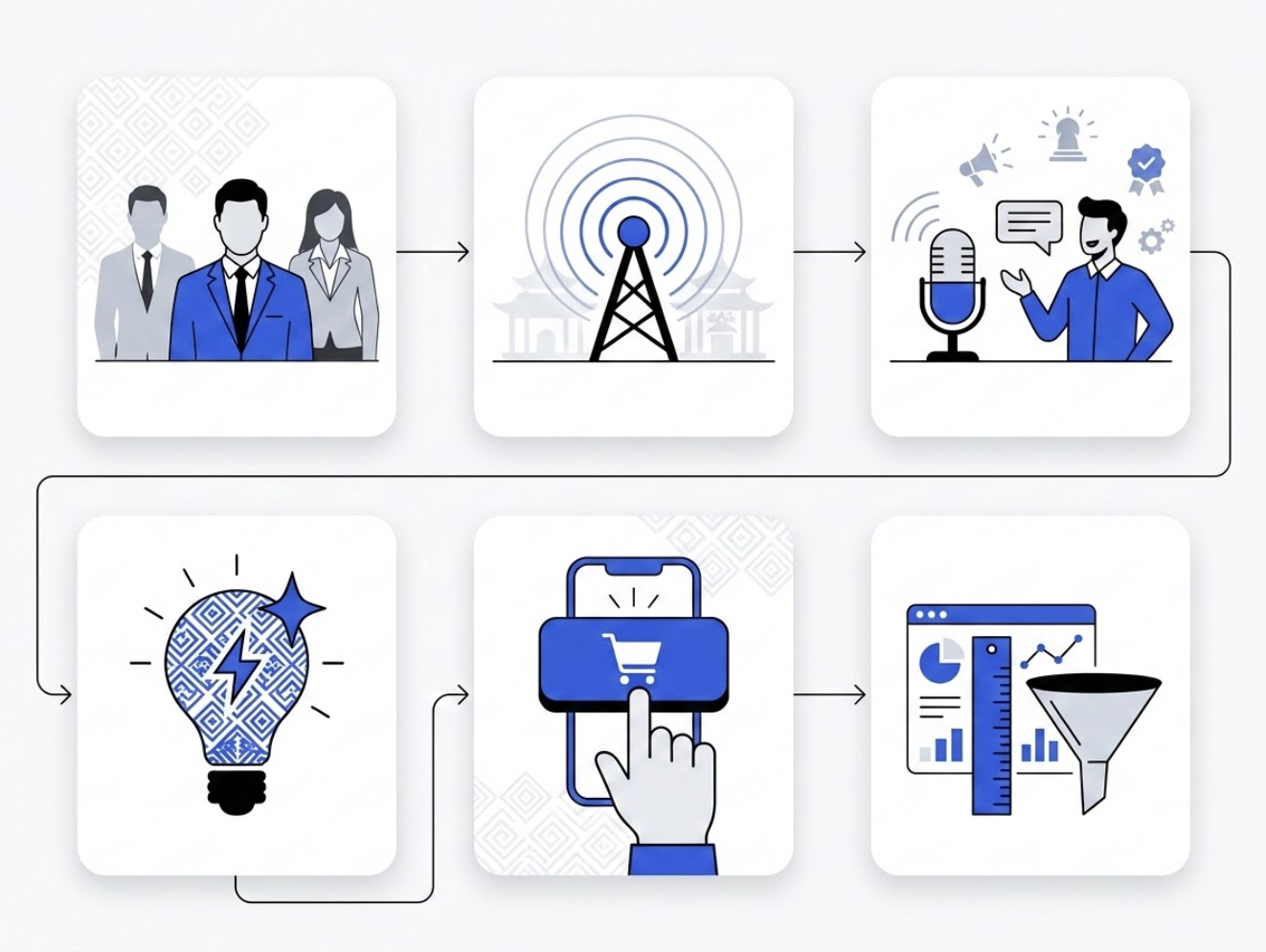
Influencer performance comes from a chain of six elements: audience fit, credible format-level reach, creator context, the creative idea, a clear audience action and measurement. Follower count can remain a scale signal. It should not open the evaluation or decide the winner.
Audience fit answers who the brand can meet. Reach estimates the unique accounts that received the media. Context explains why the audience might listen. Creative execution makes the claim relevant. The call to action and measurement connect attention to a recorded next step.
Muna Media's public UnionPay case shows why these measures should stay separate. The page reports 130,260 total reach for featured Stories, 91,940 total reach for publications, 2,573 total clicks from bloggers and a 13.91% average post engagement rate. Those are four different signals: Story delivery, post delivery, an action and interaction with posts.
The same page reports Telegram activity separately: a channel audience of 2,966,000, total publication reach of 1,151,439, 38 publications and 38 Telegram channels. Channel audience is not publication reach. These Telegram figures should not be blended with the influencer figures or relabelled as sales. The page documents work and visible campaign metrics. It does not provide a controlled estimate of incremental transactions, revenue or causal effect.
This distinction improves decisions. A manager can see what the team bought, what the channels delivered and which action tracking recorded. Evidence of incremental impact needs a stronger design, such as a baseline, geographic or timing test, or a control group where feasible.
4. The replacement system: how to select and run creators
Step 1. Start with the business decision
Choose one primary outcome. It could be landing-page visits, registrations, code use, enquiries, store visits or message recall. Do not assign every objective to every creator. An awareness placement can use delivery and attention measures. An action campaign needs a clear path after exposure. A sales claim requires data beyond the click and a defensible way to assess the contribution of advertising.
Step 2. Define the audience precisely
Specify country, city, language, age range, category and buying situation. In Uzbekistan, check the language of the creator's actual content, not only the language listed in a media kit. Uzbek-language and Russian-language executions may serve different audiences or roles even within one profile.
Request the available audience breakdown and record its date. Treat missing data as uncertainty, not proof of poor quality.
Step 3. Request placement-level evidence
Ask for reach and interactions from recent comparable pieces in the format you intend to buy. Use a series, not one record. Note the time window, whether paid promotion was involved, deleted content and how averages were calculated.
Collect Story data quickly. Meta's current developer documentation says Story media metrics are available for a limited period. The reporting clause should set a deadline and list the screenshots or exports required after publication.

Check anomalies before payment. Sudden follower growth, repetitive comments, geographic mismatch or views far outside the normal range deserve an explanation. None proves fraud by itself. The audit should expose uncertainty and set verifiable terms.
Step 4. Assess the creator's right to speak
Review several weeks of content, not only the media kit. How does the creator handle questions? Which brands appeared recently? Is there a category conflict? Can the product fit a situation the audience already associates with this person?
A smaller creator can be stronger when the subject fits their established expertise or routine. The audience already understands why this person is discussing the problem.
Step 5. Build a brief with useful boundaries
Give the creator one message, one next step and the facts that must remain accurate. List prohibited claims, mandatory qualifications, disclosure rules and content rights separately. Avoid writing every line unless regulation or product complexity requires it.
Set acceptance terms in the agreement: format, length, publication window, links, brand tags, retention period, revision rounds, usage rights and the post-publication data to provide. Creative freedom then operates inside a clear commercial scope.
Step 6. Map metrics to the funnel
Structure the report in four levels:
- Delivery: reach, views, frequency and completion measures where available.
- Attention and response: saves, comments, shares, replies and profile activity.
- Action: link clicks, code use, landing-page sessions, registrations or enquiries.
- Business effect: verified purchases, gross profit, acquisition cost and incrementality only when the data and method support them.
Do not move a conclusion from one level to the next. High reach does not prove interest. Many clicks do not prove sales. Sales rising during the campaign do not prove causation when price, distribution, seasonality and other media changed at the same time.
Use platform definitions consistently. Label organic and promoted figures, and do not compare unlike measures without a clear note.
Step 7. Run a small test before scaling
Split an initial budget across several plausible creators, formats or ideas with comparable tracking. Evaluate credible reach, response quality, clicks, landing-page behaviour and the strongest available business signal.
Scale the working combination, not the most famous name. A small test cannot remove uncertainty, but it makes uncertainty cheaper and produces evidence for this product, market and execution.
5. Decision checklist before signing
- The campaign has one primary outcome and a defined success rule.
- The creator's country, city, language and category fit the intended audience.
- The team reviewed evidence for the format it plans to buy.
- The evidence covers a comparable period, not one selected hit.
- Followers, reach, views, interactions and clicks remain separate measures.
- Organic delivery is distinguished from paid or boosted distribution.
- Recent content supports the creator's credibility on the subject.
- The brief states one message, one next step, claim limits and disclosure rules.
- The contract covers timing, revisions, content rights and required reporting.
- Links, codes and analytics are tested before publication.
- The report will not relabel reach, clicks or correlation as sales or causal impact.
- The team has a rule for stopping, retesting or scaling.
Follower count can help estimate potential scale. A budget decision needs the full working system. That is how a brand buys a credible chance of the right action rather than the appearance of a large audience.
If you need a defensible creator selection, launch and measurement system rather than a list of large profiles, we can map the audience, campaign role and evidence path before budget is committed.
Discuss your campaign
Sources
- Instagram Media Insights, Meta for Developers. Supports the distinction between reach, interactions, profile activity, link clicks and other media actions, as well as reporting limitations and data delays. Accessed 30 July 2026. Caveat: the documentation applies to professional accounts and Meta's API; available metrics and definitions can change.
- Instagram Platform Insights, Meta for Developers. Supports the separation of account insights from media insights and the use of different endpoints to retrieve them. Accessed 30 July 2026. Caveat: this is platform technical documentation, not evidence of advertising's business impact.
- Disclosures 101 for Social Media Influencers, Federal Trade Commission. Supports the guidance to make material brand relationships clear, hard to miss, close to the endorsement and in the endorsement's language. Accessed 30 July 2026. Caveat: FTC guidance concerns US law; campaigns in Uzbekistan or elsewhere require separate review of local law and platform rules.
- UnionPay International case, Muna Media. Supports the figures visible on the Russian-language case page: 130,260 total reach of featured Stories, 91,940 total reach of publications, 2,573 total clicks from bloggers and a 13.91% average post engagement rate; separately, a Telegram channel audience of 2,966,000, total publication reach of 1,151,439, 38 publications and 38 channels. Accessed 30 July 2026. Caveat: this first-party case documents reported work and metrics; it does not establish sales or a causal campaign effect.
- Influencer Marketing in Uzbekistan, Muna Media. Supports Muna Media's described process covering audience analysis, creator criteria, bot checks, creative development, planning and reporting. Accessed 30 July 2026. Caveat: this is a Muna Media service page, not independent evidence of effectiveness.