




“Should we put the budget into outdoor or digital?” sounds like a disciplined question. It forces a choice, invites a spreadsheet and promises one accountable winner. It is also often the wrong starting point.
Outdoor and digital do not have to perform the same job. One can create broad physical visibility or repeated exposure along a route. The other can answer an active query, retarget an interested visitor or capture a measurable action. When a team judges both by one platform metric, it removes the reason to use a mix in the first place.
The better principle is to assign every channel a role in the customer journey, connect the creative and offer, then measure the combined system against a business outcome.
The familiar belief: one channel should dominate
Budget discussions often turn into channel advocacy. The outdoor team presents reach and locations. The digital team presents clicks, conversions and audience controls. Finance asks which channel generated the sale. The channel with the shortest visible path to an action usually wins.
That comparison is not neutral. Digital platforms can record a click and attach it to a later event. An outdoor exposure rarely carries a person-level click trail. If last-click attribution becomes the common score, the measurement system gives digital credit for being observable, not necessarily for creating all the demand.
The reverse mistake also happens. A large outdoor audience estimate can look like proof of market impact even when the placement, viewability, message or frequency was weak. Delivery is not the same as business effect in either channel.
Start by separating exposure, attention, action and outcome
The Media Rating Council’s 2025 out-of-home standards distinguish location traffic, gross impressions, viewable or opportunity-to-see impressions, likelihood-to-see impressions and audience. These are not interchangeable labels for one number. The standard requires definitions, disclosure and empirical support because a person passing a location is not automatically a person who saw an ad.
Digital measurement has its own ladder. An impression is not attention. A click is not a qualified customer. A tracked conversion is not always incremental revenue. Platform reports are useful for delivery and optimisation, but they do not by themselves prove what would have happened without the campaign.
A cross-channel plan becomes clearer when it names four layers:
- Delivery: Was the placement served or installed as planned?
- Exposure and attention: Did the intended audience have a credible opportunity to notice it?
- Action: Did people search, visit, scan, register, contact or purchase?
- Business outcome: Did qualified demand, sales, gross profit or another agreed result change?
Each layer answers a different question. The plan should not jump from the first to the fourth without evidence.
Channel roles are hypotheses, not permanent labels
Outdoor is often useful when a brand needs physical presence, broad geographic visibility, repeated contact on commuting routes or a public signal that a product is available in the market. Digital is often useful when the brand needs addressable distribution, message variation, direct response, retargeting or fast feedback.
“Often” matters. A digital video campaign can build broad awareness. A QR-enabled outdoor placement can invite a direct action. Context, format, audience behaviour and creative execution determine the role.
Write the role as a hypothesis:
- Outdoor will make the launch visible across priority city routes among the broad category audience.
- Search and social will help interested people evaluate the offer and take the next action.
- Retargeting will continue the message for people who visited but did not complete that action.
Now the channels complement one another. They no longer compete to be a universal solution.
Design the handoff before buying media
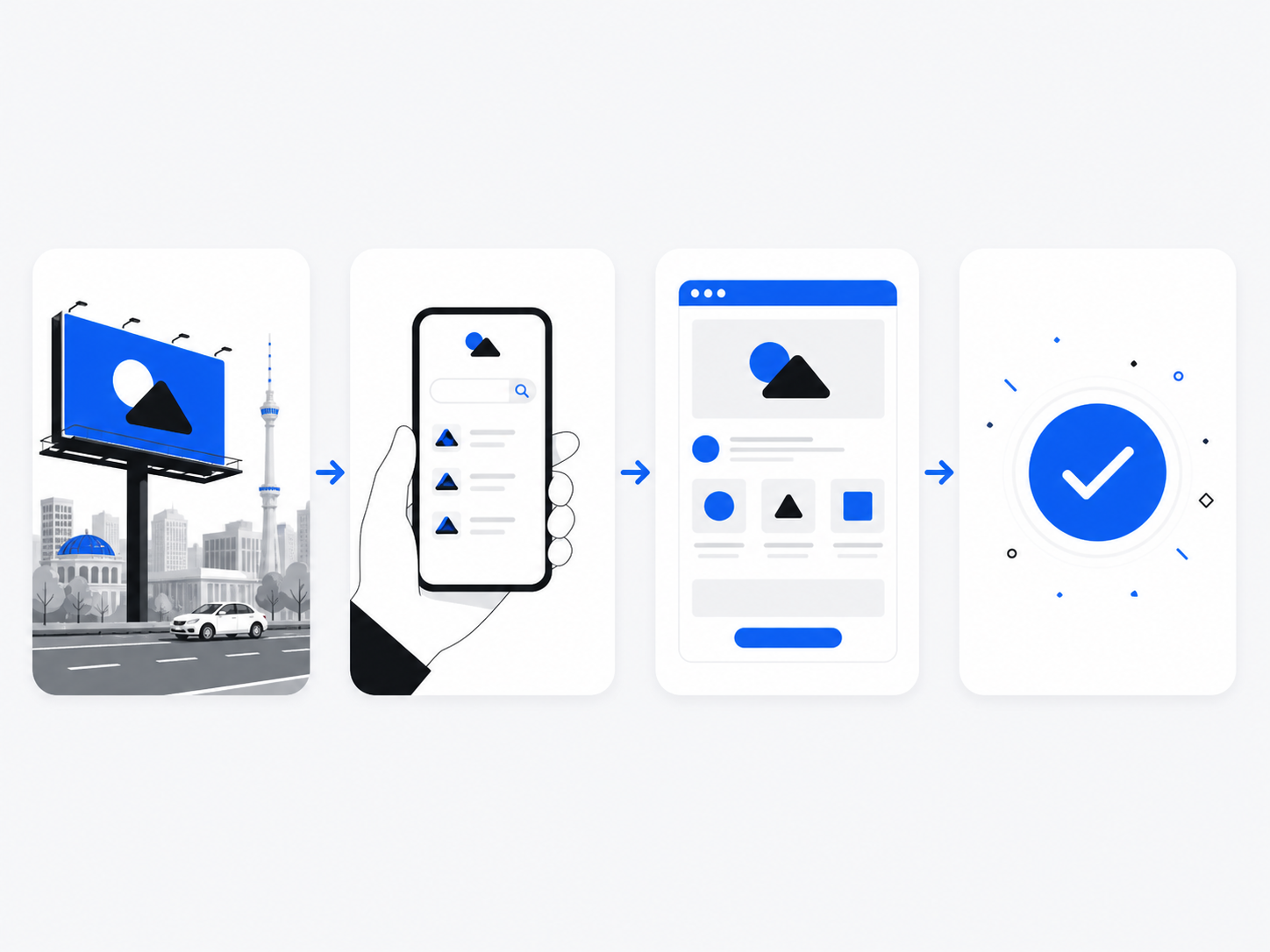
Imagine a commuter sees a campaign on a bus shelter in Tashkent. Later, the person searches the brand name, opens a social post or visits a marketplace directly. Last-click reporting may credit search, social or the marketplace. The outdoor contact may have contributed, but the path does not prove that it did.
The team can still design a better handoff:
- use the same proposition and visual memory cues across formats;
- make the product name and next step easy to remember;
- ensure search results and landing pages answer the promise made outdoors;
- adapt the message to each format instead of shrinking one master artwork;
- align geography and timing so digital activity supports exposed markets;
- prepare customer service and sales teams for the campaign message.
A QR code can help in the right context, but it is not a complete bridge. Many people will not scan while moving. Brand search, direct visits and later retail behaviour may be part of the response too.
What integrated execution looks like
Muna Media’s public KoronaPay case offers a useful first-party example of channel integration in Uzbekistan. The page lists LED screens in several cities, bus and metro placements, branded stops, targeted Facebook and Instagram advertising, Telegram activity, influencers and video production. That confirms a coordinated mix was executed. It does not isolate which channel caused the reported business outcomes, so the case should not be used as a universal uplift benchmark.
The UnionPay case shows a different mix: a campaign website and Telegram chatbot, social content, leaflet distribution, targeted advertising and influencer collaborations. Again, the useful lesson is operational. The customer journey crossed physical and digital contact points, and the campaign mechanics connected information, participation and support.
Cases like these are more helpful when teams study the system design rather than copy the channel list. A financial app, a retail promotion and a consumer launch may need different roles, sequencing and proof.
A replacement planning system
1. Define one business outcome and decision window
Choose the result the campaign should influence and the period in which a change is plausible. Avoid using “awareness and sales” as one undifferentiated target. If both matter, define separate measures and explain how they relate.
Document external factors that can move the outcome: price, distribution, seasonality, competitor activity, stock, product changes and sales operations.

2. Map audience states
Describe what the audience needs at each stage. Someone unfamiliar with the brand needs recognition and relevance. Someone comparing options needs proof. Someone ready to act needs a clear offer, access and low friction.
Assign channels to those needs. Do not start from available inventory.
3. Write a role and metric ladder for every channel
For each channel, record:
- the audience state it addresses;
- the message and format;
- the expected handoff;
- delivery evidence;
- an attention or exposure measure where credible;
- an action measure;
- the business outcome it may contribute to;
- what the data cannot prove.
This last line prevents an impression, click or scan from becoming a causal claim by accident.
4. Coordinate creative and operations
Build one campaign idea with channel-specific executions. Outdoor needs recognition at distance and speed. Digital can explain, compare and capture action. Landing pages, retail availability, call centres and sales scripts must keep the promise consistent.
Plan production dependencies early. A perfect media schedule cannot rescue late artwork, an unavailable product or a landing page that contradicts the outdoor message.
5. Design measurement before launch
Use the strongest method the budget and market allow. Options include matched geographic tests, holdout audiences, brand-lift research, controlled experiments for selected digital activity, search and direct-traffic trends, retail or sales data, and media mix modelling over sufficient history.
Google’s open-source Meridian framework illustrates why media mix modelling is not a magic attribution machine. It estimates channel contribution through a causal framework and assumptions, uses controls, models lag and saturation, and reports uncertainty. Business knowledge and data quality shape the result.
For cross-media audience measurement, the World Federation of Advertisers’ Halo initiative responds to fragmented, siloed systems with an open and privacy-focused framework. WFA also states that Halo is not an off-the-shelf tool or complete standard. Local data, governance and implementation still matter.
6. Reallocate by evidence, not ideology
Review channel performance at the level each method can support. Fix delivery failures first. Then examine audience quality, handoffs, outcomes and uncertainty. A channel with weak last-click results may still deserve investment if a controlled test shows an incremental contribution. A channel with many reported conversions may deserve less if those conversions would have happened anyway.
Budget allocation is a portfolio decision. It should account for marginal return, saturation, reach, frequency, risk and the role of the whole mix.
Decision checklist
Before choosing between outdoor and digital, ask:
- What business outcome and decision window are we planning for?
- Which audience state does each channel address?
- What should happen after each exposure?
- Are the proposition and memory cues connected across formats?
- Do delivery, exposure, action and outcome have separate measures?
- What does each metric fail to prove?
- Can we use a holdout, geographic comparison or another stronger design?
- Are sales, distribution and customer operations ready for the campaign?
- Will budget move according to marginal evidence rather than channel politics?
Outdoor and digital should compete for a useful role and a justified budget, not for the title of “main channel.” The campaign wins when the parts create a path the customer can follow and a measurement system the business can trust.
If your budget discussion is stuck at “outdoor or digital,” Muna Media can help define channel roles, coordinate execution and build a measurement plan around the combined campaign.
Discuss your campaign