




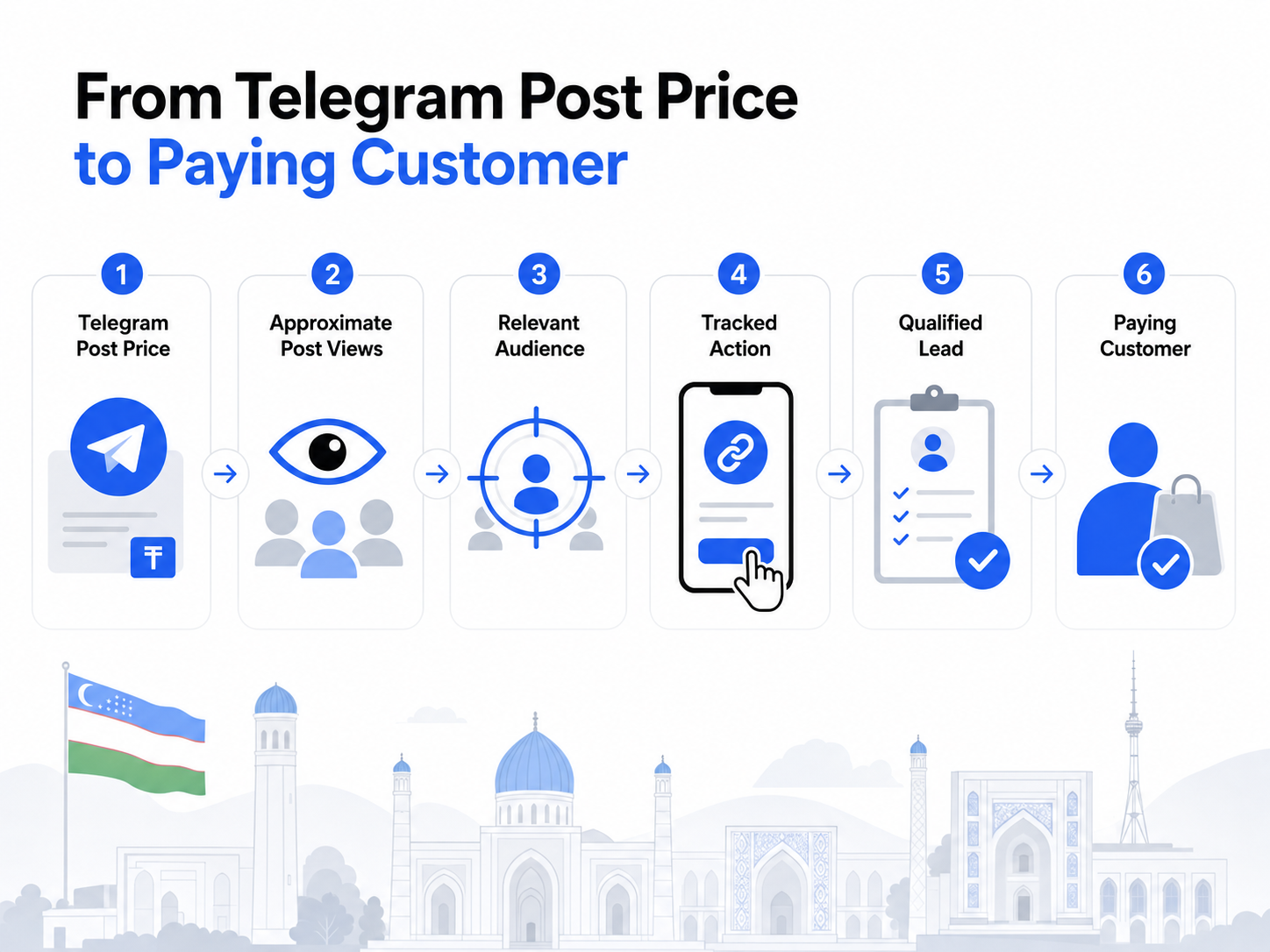
A cheap Telegram post can be a good media buy. It can also be the first cheap step in an expensive acquisition journey. Post price tells you what the placement costs. Even CPM only tells you the price of one thousand ad views. Neither metric tells you who paid attention, who acted, or who became a customer.
The point is not that Telegram fails. The point is to measure its assigned job and keep delivery, audience fit and business outcomes separate.
1. The familiar belief: a cheap post means an efficient channel
The buying logic is simple. A manager collects prices from several channels, reviews subscriber counts or screenshots of previous post views, and picks the lowest offer. Teams may calculate a CPM to compare channels of different sizes. The lower the post price or CPM, the better the line looks in the media plan.
That calculation has a valid but narrow use. It compares the cost of ad delivery. Telegram defines CPM on its advertising platform as the price for one thousand ad views. CPM is not cost per click, qualified enquiry or paying customer.
The plan must also distinguish two buying routes. A direct placement is a post negotiated with a channel owner or sales manager. Telegram Ads is the official sponsored-message platform. Telegram says it serves public one-to-many channels with at least 1,000 subscribers. Sponsored-message links must point to a Telegram destination, such as a channel or bot. External website links are not allowed.
These routes have different constraints, user journeys and measurement options. A direct post price and an official Telegram Ads CPM do not represent the same product. Putting both under one label, “Telegram advertising,” makes the cheapest number look more comparable than it is.
2. Where the price-first model breaks
The first break sits between views and people. Telegram’s Channels FAQ says a post counter includes views from forwarded copies. The number is approximate. After a short period, around four days, Telegram may forget that someone has seen a post and count that viewer again if they return. A post view therefore does not equal one unique person.
This boundary matters in reports. The eye counter helps describe how far a post has spread. It does not prove unique reach, clicks, intent or sales. Calling every view a person inflates the apparent audience before the commercial analysis has even begun.
The second break is audience fit. A channel can deliver many views while reaching too few people with the right need, location, language or ability to buy. A general news channel, a professional community and an entertainment feed might quote the same post price. Their value will differ for a bank product, a business service or a retail launch.
The third break is the message. A relevant audience cannot rescue an unclear benefit, weak offer or missing next step. The headline, introduction and surrounding posts shape attention but do not appear in the placement price.
The fourth break begins after the click. A slow site, confusing form, wrong language or delayed sales response can turn inexpensive traffic into expensive acquisition. A report that ends with views and clicks cannot locate that loss.
The fifth break is action quality. Two placements can generate the same number of enquiries. One may produce casual questions; the other may produce fewer but better-fit opportunities. Cost per lead is still incomplete unless teams use the same definition of a qualified lead, customer and acquisition window.
3. The alternative truth: evaluate the acquisition chain
A better question is: “Which route produces an acceptable cost for the outcome we need, within the available evidence?” The route runs from buying and delivery through qualification and payment.
For direct placements, keep at least three metrics separate:
- the post price;
- the cost per thousand recorded post views, with the observation time stated;
- the cost of the business outcome your systems can confirm.
The final outcome depends on the campaign. An online retailer may use a paid order. A B2B service with a long sales cycle may use a qualified opportunity while clearly labelling it as an interim outcome. Decide the definition before launch. Do not choose it later to make the report look better.

Muna Media’s UnionPay case shows why the layers should remain separate. It reports a channel audience of 2 966 000, total publication reach of 1 151 439, 38 publications and 38 Telegram channels. These first-party figures describe placement scale, not sales, unique people or Telegram’s causal contribution. The case also includes a website, Telegram bot, receipt uploads, social media, influencers and offline activity. Assigning the integrated system’s outcome to one channel would require further evidence.
4. The replacement system: plan from outcome to placement
Define the outcome and accounting rules
Start with the event the business is willing to fund: a verified enquiry, a meeting with a suitable company, an activated user or a paid order. State who confirms the event, where it is stored and how long the acquisition window lasts. Decide which costs enter the calculation, including media, production, agency fees or other agreed acquisition costs.
Do not label an observed path as causal lift. A purchase after a tracked click connects events in analytics, but it does not prove the customer would not have bought without the ad. That question needs a separate measurement design, such as an appropriate control comparison, when the campaign scale and conditions support it.
Choose the Telegram route
For direct placements, decide whether the post should send people to a site, app, sales contact or bot. For Telegram Ads, account for the external-link restriction. An official sponsored message can point to a Telegram channel or bot, so the journey to a website or purchase may need an intermediate Telegram step.
Muna Media’s Telegram marketing page treats channel placements and Telegram Ads as separate services. It also describes channel checks, tracking links and funnel monitoring. This is a useful service framework, but each campaign still needs its own evidence and decision rules.
Review channels before buying
Do not rely on subscriber count or one strong screenshot. Request a sequence of normal posts over a comparable period. Review topic, language, geographic context, advertising load, stability of recorded views and discussion quality where comments are available. Record when each view count was observed because the counter changes and Telegram labels it approximate.
Agree the format, date, time, time online, edit rules, disclosure requirements and post-campaign evidence with the channel owner. These terms do not guarantee performance. They make the delivery auditable and reduce disputes after publication.
Build tracking before publication
When a direct placement leads to a website, use a separate destination URL for every channel and creative version. Google Analytics says UTM campaign parameters added to destination URLs show which campaigns refer traffic. utm_source identifies the source, utm_medium the marketing medium, utm_campaign the campaign and utm_content the creative variation. Google also recommends a standard, case-sensitive naming convention so reports do not split one campaign into inconsistent rows.
UTM parameters have limits. They describe tagged traffic when analytics works and the journey remains observable. They do not identify everyone who saw a post. Connect analytics to the form or CRM. Give bot entry points separate identifiers where possible. Account for promo-code sharing, and test the mobile journey before launch.
Do not place a UTM-tagged external website URL directly in an official Telegram Ads sponsored message. Telegram does not allow external links in that format. Instead, design and measure the permitted channel or bot step, then instrument later transitions where possible.
Test combinations, not price lists
Compare the channel, message, offer and next step as one combination. Start with a controlled test of delivery, tracking and early actions. Do not declare a winner after a handful of conversions. Set rules for stopping, revising and scaling before results arrive.
Keep four reporting layers separate: delivery, attention, actions and business outcome. Delivery can include spend and recorded views. Actions can include tracked clicks, bot starts or form submissions. Business outcomes should include only agreed qualified events and payments. If late-stage data is not available, report the gap. Do not replace it with reach.
5. Decision checklist before you buy
- Direct channel placements and Telegram Ads are separate lines in the plan and report.
- The target business outcome is defined before launch and confirmed in a system of record.
- The channel fits the required topic, language, geography and consumption context.
- The team reviewed a sequence of normal posts, not one selected screenshot.
- View observation times are recorded, and post views are not labelled as unique people.
- Each direct placement has a distinct tagged link or another traceable identifier.
- The journey through channel, bot, site, form and sales response works on a phone.
- Reports separate views, clicks, enquiries, qualification and payment.
- Stop, revision and scale rules were agreed before results arrived.
- No report assigns sales or lift to Telegram without evidence designed to support that claim.
A low placement price can still signal a useful opportunity. You only know after testing the complete chain. Post price starts the commercial calculation; it does not finish it.
Planning Telegram placements? Muna Media can help separate the buying routes, assess channels and connect media delivery to a measurable customer journey.
Discuss your campaign
Sources
- Telegram Channels FAQ: What does the eye icon mean?. Supports the limits of the post view counter: forwarded copies are included, values are approximate, and a returning viewer may be counted again after around four days. Accessed 30 July 2026. Caveat: this explains counter mechanics, not advertising outcomes.
- Telegram Ad Platform Explained. Supports the official Telegram Ads conditions: sponsored messages in public channels with 1,000 or more subscribers, CPM as the price of one thousand views, and no external links. Accessed 30 July 2026. Caveat: these rules apply to Telegram’s official ad platform, not directly negotiated channel posts.
- Google Analytics: URL builders, collect campaign data with custom URLs. Supports the use of UTM parameters, campaign data after a click, and consistent naming. Accessed 30 July 2026. Caveat: UTM data describes tagged traffic and does not establish causal impact.
- UnionPay International case. Supports the published Telegram placement figures and the campaign’s wider mechanics on the Russian-language case page. Accessed 30 July 2026. Caveat: this is a first-party Muna Media case; its audience and reach figures are not unique people, sales or proof of one channel’s causal effect.
- Telegram Marketing Services in Uzbekistan. Supports Muna Media’s distinction between channel placements and Telegram Ads and its stated use of channel checks, tracking links and funnel monitoring. Accessed 30 July 2026. Caveat: this is a provider’s service page, not an independent industry standard.