


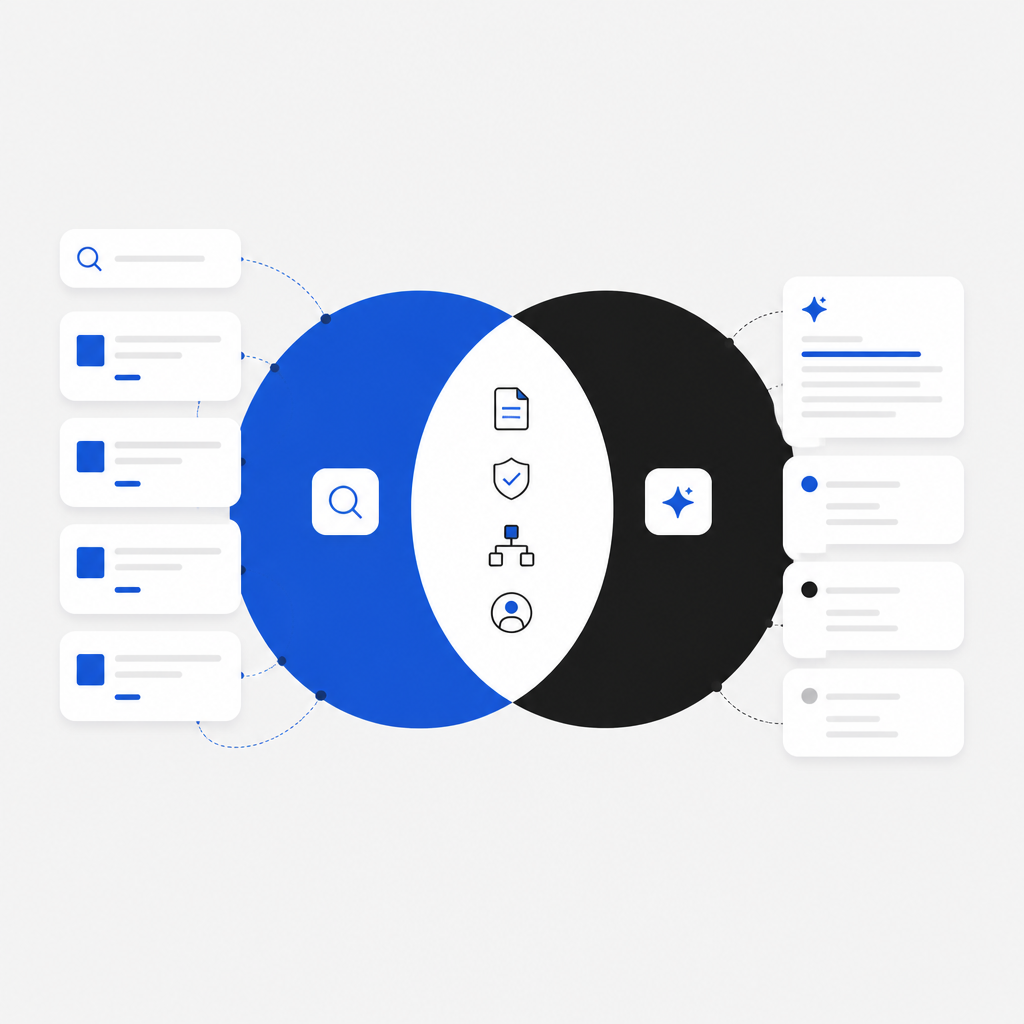
A page can rank first for a Google query and still be absent from an AI-generated answer. Another page can appear as a supporting link in an AI response without holding the first classic result for the wording a marketer tested. These outcomes are related, but they are not interchangeable.
That distinction matters because brands are starting to replace one simplistic target with another. “Rank number one” becomes “get cited by every AI.” Both targets ignore the question behind visibility: can the right customer find, understand and trust the brand when making a decision?
The better principle is to protect search fundamentals, make important information easy to retrieve and verify, then measure classic search and AI-answer visibility as separate surfaces.
The familiar belief: search position controls the answer
Traditional SEO trained teams to inspect a results page, record a position and compare it over time. That model is already more complex than one rank because results vary by query, location, device, language and intent. AI answers add another layer.
Google says AI Overviews and AI Mode can use “query fan-out,” issuing several related searches across subtopics and data sources. Google also says the two features may use different models and techniques, so their responses and supporting links can vary. An answer may synthesise sources selected for different parts of a question rather than reproduce the order of one classic results page.
This does not mean ranking has become irrelevant. It means one observed rank cannot guarantee selection in every generated response.
Eligibility is not the same as selection
Google’s official guidance draws a useful line. To be eligible as a supporting link in AI Overviews or AI Mode, a page must be indexed and eligible to appear in Search with a snippet. There are no extra technical requirements. That is an eligibility rule, not a promise that an eligible page will be cited.
The same difference appears outside Google. OpenAI documents a dedicated OAI-SearchBot for surfacing websites in ChatGPT search. It is independent from GPTBot, which controls potential use for training foundation models. Perplexity also documents a search crawler, PerplexityBot, separately from user-triggered fetching.
A site can therefore be healthy in Google while blocking another answer engine at robots.txt, a firewall or a CDN. Conversely, allowing a crawler only permits access. It does not establish relevance, accuracy or authority.
AI visibility does not replace SEO
The most reliable work is still foundational. Google explicitly recommends the same SEO practices for its AI features as for Search overall:
- allow crawling through robots.txt, hosting and CDN controls;
- make pages discoverable through internal links;
- provide a good page experience;
- keep important information in textual form;
- ensure structured data matches the visible page;
- maintain current business and merchant information where relevant.
These steps solve access and comprehension problems. They cannot force a citation. Yet skipping them creates avoidable reasons for a system not to use the page at all.
This is why “AEO instead of SEO” is a false choice. Answer visibility sits on an information base that search teams already know how to build: crawlable pages, stable URLs, clear site structure, useful content and accountable sources.
Where answer-focused work is genuinely different
Classic keyword pages often target a short phrase. A decision-maker’s AI prompt may contain a situation, constraints and a comparison: “Which campaign approach fits a financial brand entering Uzbekistan if we need Russian and Uzbek localisation, offline reach and measurable digital action?”
A page built only to repeat a broad keyword may not answer those component questions. A useful source does more:
- states who the guidance is for and where it applies;
- gives a direct answer before background;
- separates facts, interpretation and recommendations;
- defines terms consistently;
- cites original sources close to the claim;
- names the author or organisation responsible;
- shows when time-sensitive information was reviewed;
- links to deeper pages without hiding the main answer.
These practices help readers first. They may also make passages easier for systems to retrieve and quote. That second effect should be treated as an operating hypothesis, not a universal ranking factor. No publisher controls how every answer engine weighs a source.
The expensive mistakes of “AI optimisation”
Publishing hundreds of thin answer pages
Google’s people-first content guidance asks whether a site is using extensive automation to produce content across many topics and whether mass production reduces care. Turning every possible prompt into a shallow page can create duplication without adding original evidence or expertise.
The useful unit is not “one page per prompt.” It is one strong information asset per meaningful customer problem, supported by service detail, cases, methods and sources.
Adding schema that says more than the page
Structured data is not a hidden claim channel. Google says it should match visible text. Marking a page as an FAQ, review or organisation does not make unsupported statements true and does not guarantee an AI citation.
Use schema to describe content accurately. Do not use it to manufacture authority.
Treating third-party mentions as a magic quota
Consistent information about a brand across credible external sources can help people verify who the organisation is and what it does. But there is no official universal count of mentions, links or directory listings that guarantees inclusion in AI answers.
Build external presence for legitimate reasons: original research, useful commentary, partnerships, case documentation and accurate profiles. Record the resulting citations, but do not sell a fixed citation recipe as certainty.
Tracking a few prompts by hand and calling it market share
AI responses can vary by wording, model, location, account state and time. A screenshot proves what appeared in one observation. It does not prove permanent visibility or absence.
Measurement needs a stable protocol.
A replacement system for search and AI visibility

1. Protect the technical base
Audit canonical URLs, indexability, rendering, internal links, sitemaps, page speed and structured data. Check robots.txt and firewall rules for the crawlers the business chooses to allow. Verify crawler identity through published IP ranges instead of trusting a user-agent string alone.
Keep training controls separate from search inclusion. OpenAI’s documentation shows why: OAI-SearchBot and GPTBot have different purposes.
2. Map customer questions to evidence
Start with real sales, support and research questions. Group them by decision stage: discovering a problem, comparing approaches, checking capability, evaluating proof and choosing a next step.
For each cluster, identify the evidence the reader needs. A service page explains scope. A case page shows confirmed work. A method page explains process. An article interprets a hard decision. None should pretend to replace the others.
3. Make the answer extractable without flattening it
Lead each section with a clear point. Use descriptive headings, short paragraphs, lists for true lists and tables only when comparison helps. Put caveats beside the claim they limit. Link directly to primary evidence.
Do not write for a robot at the expense of a human. Google’s own guidance centres helpful, reliable, people-first content. A page that earns trust after the click remains more valuable than a passage engineered only to be quoted.
4. Establish accountable identity and freshness
Use a consistent organisation name, author identity, contact details and About page. Review product terms, locations, prices, regulations and case statements on a schedule. Show material update dates where they help the reader.
If several brand pages contradict one another, more optimisation will not solve the information problem. Fix the source of truth first.
5. Measure three layers separately
Track classic search performance with Search Console and analytics: impressions, clicks, queries, landing pages and conversions. Google currently includes traffic from AI features within the Web search type, so this report does not create a clean standalone AI Overview metric.
Track answer-engine referrals where referrer data is available. Then monitor a fixed set of decision-relevant prompts across named platforms, languages and markets. Record whether the brand is mentioned, whether a owned page is cited, which other sources appear, the answer wording and the observation date.
Finally, track business outcomes. A citation without qualified visits or better sales conversations may be interesting, but it is not automatically valuable.
6. Test changes without claiming certainty
Improve one information asset, document the change and observe a stable prompt and query set over time. Keep screenshots and raw records. Avoid attributing a movement to one edit when the model, index and competing sources also changed.
The goal is a learning system, not a guarantee.
Decision checklist
Before funding an AI-visibility programme, ask:
- Are priority pages indexable, internally linked and eligible for snippets?
- Do crawler and firewall rules reflect the company’s chosen search and training policies?
- Does each page answer a real customer decision with original value?
- Are claims sourced, dated where necessary and owned by a named author or organisation?
- Does structured data match visible content?
- Are search rankings, AI mentions, citations, referrals and conversions reported separately?
- Is prompt monitoring fixed by platform, language, market and date?
- Does the team describe observations as evidence, not as a guaranteed ranking formula?
Ranking first remains valuable when it brings the right audience to a useful page. AI citations can create another path to that page. Build for both, but do not confuse either surface with the final business result.
If your brand needs visibility across both classic search and AI answers, start with a joint audit of technical access, source quality, content structure and measurement.
Discuss your campaign
Sources
- AI features and your website. Supports query fan-out, varying responses and links, eligibility requirements, continued SEO fundamentals and combined Search Console reporting. Accessed 30 July 2026. Google documents its own products, not every answer engine.
- Creating helpful, reliable, people-first content. Supports original value, clear sourcing, accountable authorship and caution around careless mass automation. Accessed 30 July 2026. Guidance describes Google Search quality principles rather than a guaranteed citation formula.
- Overview of OpenAI Crawlers. Supports the separate roles of OAI-SearchBot, GPTBot and user-triggered fetching, plus robots.txt controls for ChatGPT search inclusion. Accessed 30 July 2026. Eligibility for crawling does not guarantee citation.
- Perplexity Crawlers. Supports the distinct roles of PerplexityBot and Perplexity-User and published crawler controls. Accessed 30 July 2026. Vendor documentation does not disclose a complete source-selection algorithm.
- SEO, AEO and GEO promotion. Confirms Muna Media’s public service scope across search and AI visibility. Accessed 30 July 2026. First-party service page; its commercial promises are not used here as independent evidence.